Why the BBC's maddest choice might just be the smartest one
The UK could have sent a well-polished pop star or a bespoke, manufactured group to Eurovision. It chose Look Mum No Computer, an inventor who makes organs out of Furbies in a Kent garage. The BBC's choice this year is either a stroke of genius or an act of self-aware desperation. Probably (a bit of) both.
The engineer behind LOOK MUM NO COMPUTER
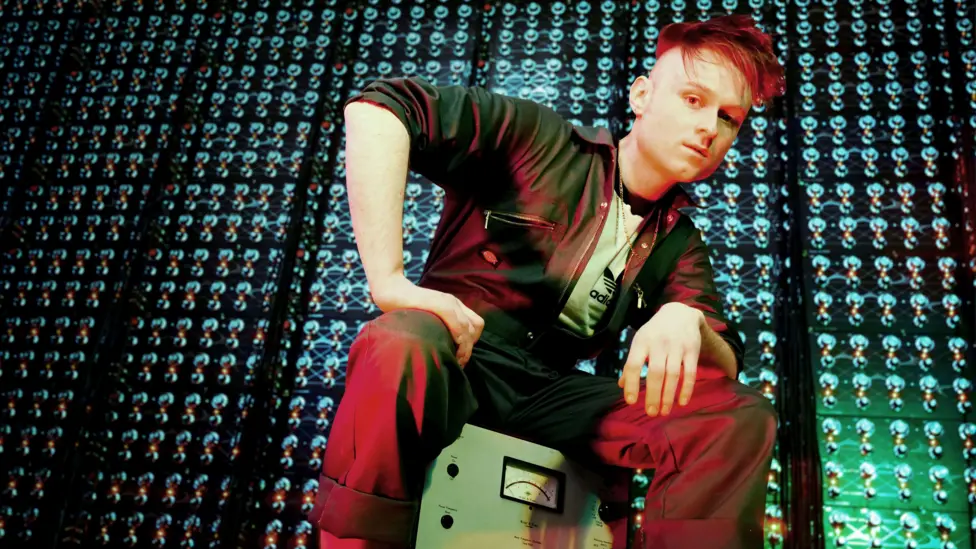
LOOK MUM NO COMPUTER is, first and foremost, Sam Battle and… he doesn’t fit into any box. He’s not a singer, not in the traditional sense at least. He’s not a producer either. He’s a sort of slightly eccentric, compulsive inventor who makes music out of whatever he can find. With vintage synths, with decorative metal plates, with thousands of oscillators connected in parallel, but what propelled him forward was that pipe organ made from 44 Furby toys all soldered together.
He is in the Guinness World Records for the world's largest drone synthesiser, he's done a TEDx Talk, he has his own video game, and a museum dedicated to obsolete technology and machines that should never have made music.
Without any serious academic training in electronics or measurement and what others call shortcomings, he calls them… a method.
«One, Two, Three» : boredom as fuel
LOOK MUM NO COMPUTER's song starts from a very simple and universal place: that of the frustrated worker who wants to quit everything. «So sick of doing the whole nine to five / I pay my dues, I’m just stayin’ alive.» It's Monday morning coffee at the office, set to synthwave. «Eins Zwei Drei"» is the pinnacle of British absurdity in the face of a life that no longer makes sense: changing language to change reality. A track that tells us that when the currency seems fake and the coffee is cold, all that's left to do is turn up the volume, count to three, and let the circuits fry the monotony.
With that self-deprecating streak characteristic of our English friends.« I’m jumping on a plane to another nation / And all my pounds feel counterfeit / I need some euros to counter it" .
A UFO certainly, but a controlled UFO
One might think the BBC is coasting along, but no! The ESC machine is running at full speed, as behind Eins, Zwei, Dreii you'll find a certain Thomas Stengaard to whom we owe no less than 4 entries this year and Only Teardrops by Emmelie de Forest, winning title for Denmark in 2013, as well as producer NYLAN co-signatory of The Code Nemo. As for the staging of the performance, it has been entrusted to an Eurovision heavyweight in the person of Fredrik Rydman.
And that's the whole paradox. While Look Mum No Computer is seen as a joke entry by an anti-establishment artist, he's surrounded by one of the most well-honed teams in the Eurovision family.
The BBC, the wall or the leap into the void
To understand LOOK MUM NO COMPUTER's choice, you have to look at the numbers. Between 2019 and 2025, the UK has accumulated... 12 public points over five participations, including two nil points in 2024 and 2025 inclusive. Sam Ryder is almost an anomaly with his second place in 2022 and his 466 points.
Thus, ever since, the BBC has tried to find the right formula each year. Mae Muller, pop star Olly Alexander, and Remember with their tellingly titled song «what the hell just happened"».
Sam Battle himself has no illusions about the workings of the contest: «There’s a lot going on with the voting, a lot of favouritism, and maybe the UK isn’t everybody’s favourite.» He says he will be «himself» on stage. And he's mentally preparing for a draw, if it happens.
This level of lucid self-deprecation is, paradoxically, what makes the entry endearing.
The BBC's winning formula?
This year, one can sense that the BBC, after years of searching for the perfect formula, sometimes at the risk of offering overly bland ones, has decided to stage a mini-revolution. Will we see a Furby organ on the stage of the Wiener Stadthalle? An instrument made from old retro synthesizers? Or a cardboard robot that counts in German? Perhaps.
Will LOOK MUM NO COMPUTER work? One thing is for sure, fan reception is rather positive. And for the first time in a long while, the question is less important than the show itself.